
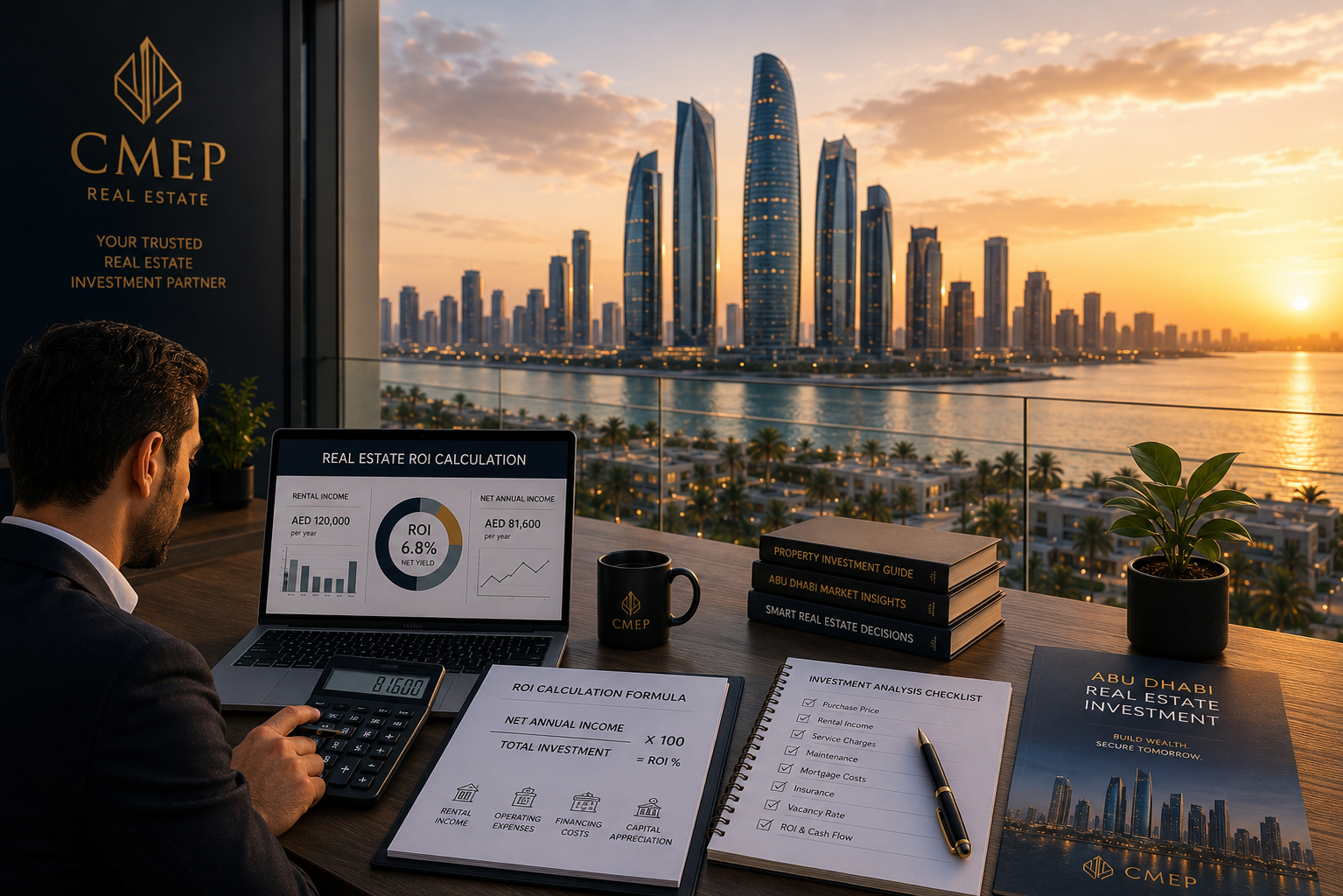
When buying property for investment in Abu Dhabi, it is not enough to ask only about the property price or expected rent. A smart investment decision requires a clear understanding of return on investment, real ownership costs, and the potential for long-term capital growth.
Real estate ROI simply means how much profit a property can generate compared to the amount you paid or committed. However, a common mistake is calculating return based only on annual rent without considering fees, expenses, financing, and possible vacancy periods.
The first step is to calculate the expected annual rental income. If the property can be rented for a certain monthly amount, multiply that number by 12 months to estimate annual income. However, this number should be realistic and based on current market demand, not only on optimistic marketing expectations.
Next, deduct annual costs from the rental income. These costs may include service charges, maintenance, insurance, property management fees, and any expenses required to prepare or maintain the unit. These expenses directly affect your net profit.
Net rental yield is more important than gross rental yield. Gross yield compares annual rent with the property price only, but it does not show the full picture. Net yield includes ownership costs, which makes it more realistic and more useful for serious investors.
If you are using mortgage financing, you must include monthly payments and financing charges in your calculation. A property may look profitable on paper, but after financing costs, the actual return may become much lower. This is why it is important to compare expected rental income with your real monthly obligations.
You should also account for possible vacancy periods. It is not guaranteed that the property will be rented for the full year. There may be time between tenants, or the unit may need marketing before being leased. A smart investor calculates a realistic scenario that includes one or more months without rental income instead of assuming full occupancy.
Another important factor is capital appreciation. Some properties may not provide the highest immediate rental return, but they may be strong in terms of long-term value growth. This usually happens in locations with continuous development, real demand, strong infrastructure, and future projects nearby.
However, you should not rely only on capital appreciation. Market conditions can change, and prices may not rise as quickly as expected. A better investment is usually balanced between reasonable rental income and future growth potential instead of depending on one factor only.
When comparing two properties, do not choose the cheaper option automatically. Compare the price, expected rent, service charges, rental demand, developer reputation, building age, finishing quality, area performance, and resale potential. Sometimes a slightly more expensive property can deliver a better return because it is easier to rent and resell.
It is also important to understand the target tenant. A smaller apartment near business districts may attract professionals, while a villa in a family community may attract long-term family tenants. Each property type has a different demand pattern, occupancy profile, and maintenance cost.
A good return does not always mean the highest number. Sometimes a very high yield may indicate higher risk, such as a less desirable location, an older building, unstable service charges, or limited resale demand. Investors should look at the quality of the return, not only the percentage.
In the end, calculating real estate ROI in Abu Dhabi requires a complete view. Calculate rental income, deduct costs, review financing, allow for vacancy periods, and compare capital growth potential. Successful real estate investment is not based on excitement. It is based on clear numbers and a well-studied decision.